Why the cheapest marking is rarely the cheapest
Floor marking quotations are almost always per linear metre of material. That number is meaningless on its own. The real cost of a line is material + preparation + labour + production time lost while the area is closed + the cost of doing it all again. Paint and tape score badly on the last two items, and those are the ones that repeat.
This article builds a simple five-year model for the same 100 m of 100 mm walkway line in three ways. The ranges are planning figures for a typical indoor concrete floor in a two-shift plant; they are not a quotation, and local labour rates will move them a lot.
The model and its assumptions
| Assumption | Value |
|---|---|
| Line to be marked | 100 m × 100 mm walkway line, straight, indoor |
| Floor | Power-floated concrete, swept, lightly dusty |
| Traffic | Forklifts and pallet trucks crossing the line 50–200 times per shift |
| Layout stability | 3 layout changes over 5 years (racking moves, new pick faces) |
| Currency / basis | USD, contractor labour, 2026 planning ranges |
| Excluded | Traffic management staff, permits, overtime premiums |
Option A: two-part epoxy paint
Installed cost: roughly $5–9 per metre ($500–900 for the run), split between material at $1.50–3 per metre and preparation, masking and two-coat application at $3–6 per metre. On a well-prepared floor it lasts three to five years under moderate forklift traffic; under heavy traffic or in a wash-down area it can fail at the edges within 18 months.
The costs that follow are the ones people forget:
- Downtime. Two coats plus recoat windows means the aisle is genuinely unusable for 24–72 hours. If that aisle carries 20% of your outbound volume, you already know what a closed day costs.
- Floor preparation. Epoxy does not bond to dust, oil or a sealed floor. Grinding or shot-blasting is often needed — and it produces a mess of its own.
- Repainting. A five-year horizon almost certainly includes one refresh: budget another $400–800 plus another closure.
- Re-layout. Three layout changes means paint stripping or a second line painted next to a wrong one. Budget $300–600 per change including labour and cure time.
Option B: vinyl floor tape
Installed cost: roughly $3–6 per metre ($300–600), material $2–4 plus $1–2 of labour. Tape is fast, needs no curing, and can be laid by your own team during a quiet shift. That is why it is the default in plants that change layout often.
Its weakness is adhesion. On dusty concrete, in wheel paths, or across a dock apron where moisture creeps under the edge, a 100 mm tape in forklift traffic typically needs replacement every 6–18 months. Over five years that is three to six re-lays, each with labour, each leaving adhesive residue that has to be cleaned before the next attempt. Realistic five-year spend: $1,500–3,000, with a rolling maintenance burden instead of one big invoice.
Tape also fails in a way that matters for safety: it lifts at the corners, and a curled edge looks like a marking while no longer reading as one from a forklift cab.
Option C: projected lines
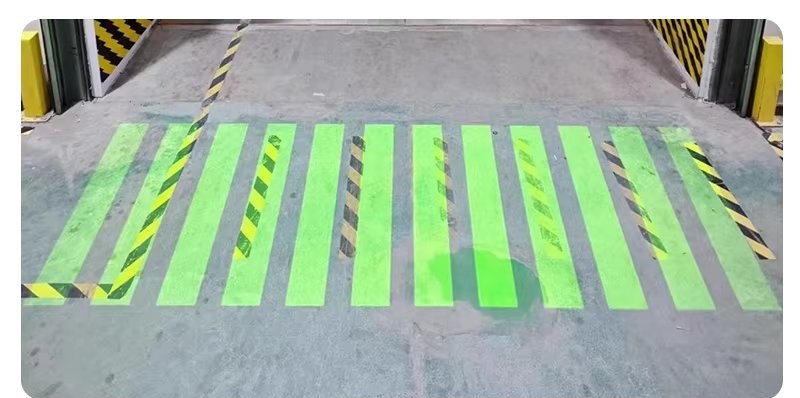
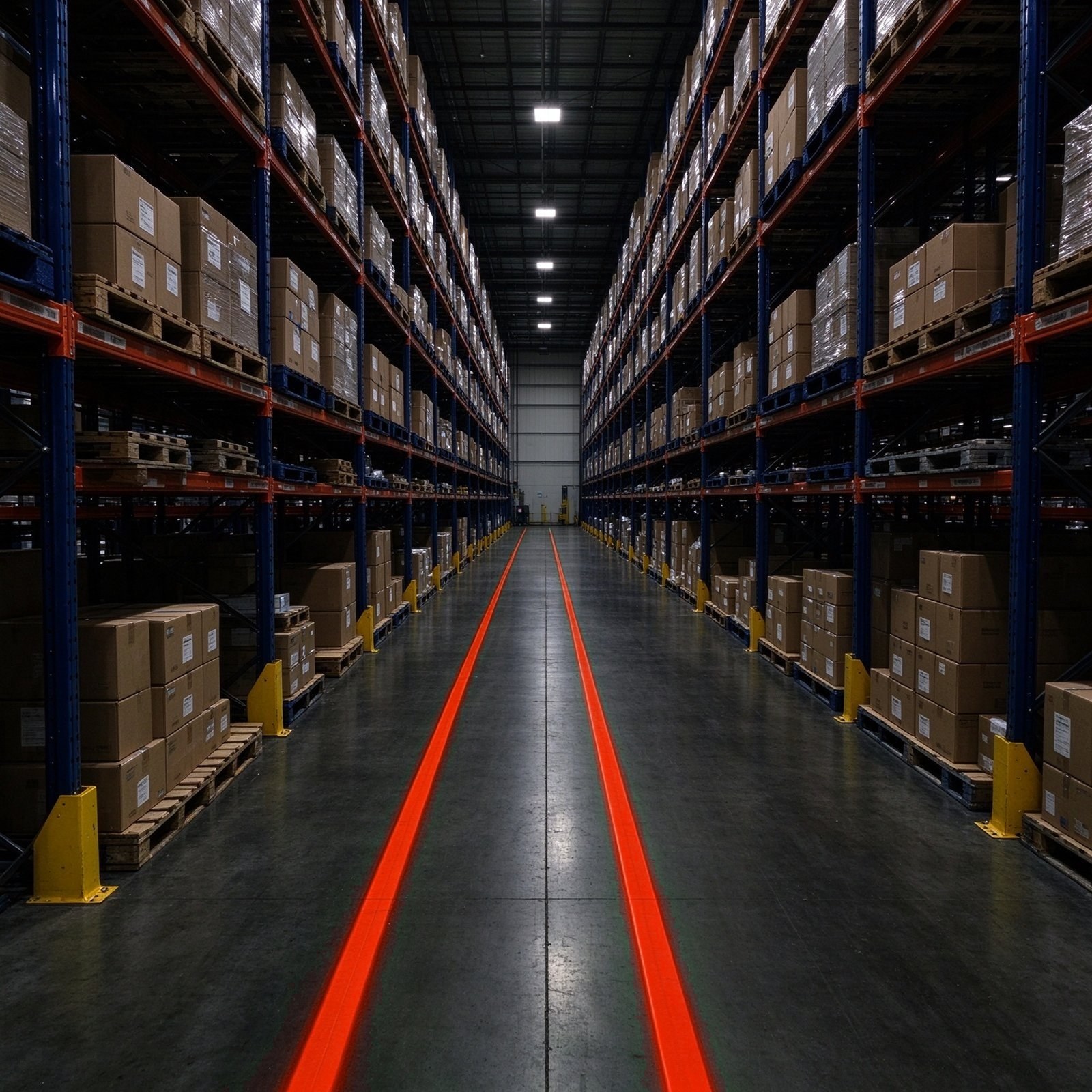
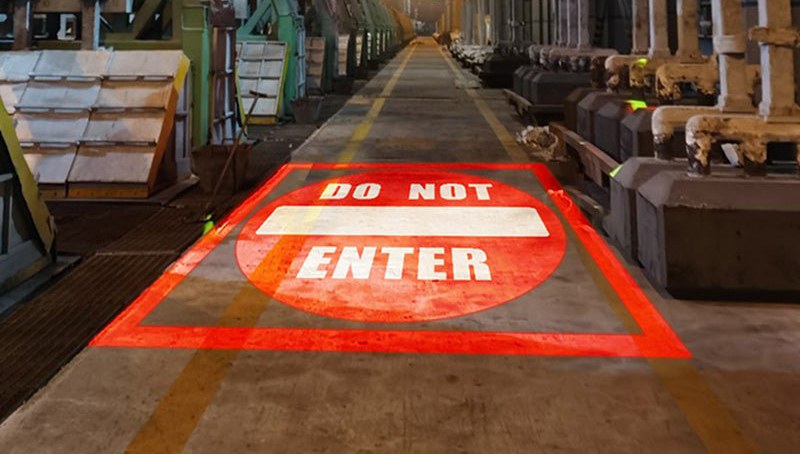
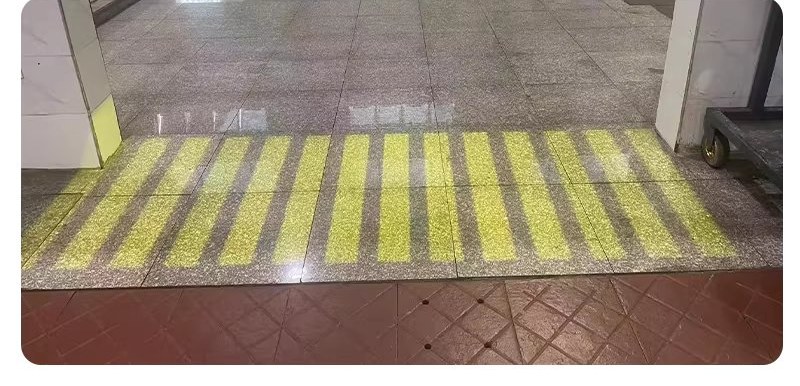
Hardware: roughly $250–900 per line unit for the 80–300 W range, plus $100–150 of installation per unit (bracket, socket, aim). One unit covers about 15–30 m of line depending on lens and mounting distance, so 100 m of walkway is typically four to six units: $1,400–5,600 installed.
Running cost is negligible — 80–300 W of LED for 4,000 hours a year is roughly $20–150 of electricity per unit at typical industrial tariffs, and the source is rated for 50,000 hours, which is more than a decade of two-shift operation.
The structural difference is what happens when the layout changes: someone loosens one screw and re-aims the line. Fifteen minutes, no closure, no material. Three layout changes over five years cost a few hours of technician time instead of three re-paint events.
Five-year totals
| Cost element | Epoxy paint | Vinyl tape | Projected lines |
|---|---|---|---|
| Initial install | $500–900 | $300–600 | $1,400–5,600 |
| Replacement / refresh | $400–800 (1×) | $1,200–2,400 (3–6×) | $0 |
| Re-layout × 3 | $900–1,800 | $900–1,800 | ~$0 (re-aim) |
| Energy over 5 years | $0 | $0 | $100–750 |
| Approx. 5-year total | $1,800–3,500 | $2,400–4,800 | $1,500–6,350 |
| Production downtime | 3–4 closed periods | 4–8 short stops | None |
| Maintenance attention | Low between repaints | Constant | Occasional re-aim |
Read the table honestly: the ranges overlap, and on a static line with light traffic paint can still be the cheapest option by a wide margin. Projection wins decisively when the line is long, the traffic is heavy, or the layout moves — and once downtime is priced in, it wins on almost any line that crosses a working aisle.
Costs the invoice hides
- Closure time. The single largest line item in most repaint projects, and the only one with no invoice attached.
- Floor damage. Adhesive residue and paint stripper both shorten the life of a sealed floor.
- Wrong-line risk. After a re-layout, an old line that nobody removed is worse than no line: it teaches people to ignore markings.
- Compliance drift. A line that has faded to a ghost still passes a casual walk-through and still fails an audit.
Where each option still wins
| If your situation is… | Best choice |
|---|---|
| Static line, light traffic, no re-layout planned | Epoxy paint — cheapest on every horizon |
| Layout changes twice a year, one person can lay tape | Vinyl tape |
| Forklift traffic crosses the line all day | Projection — tape and paint both lose edges fast |
| Floor is glossy, dusty, oily or wash-down | Projection — nothing to bond to |
| You need a line back in service today | Projection — installs without curing |
| Aisle closures are expensive | Projection — re-aim instead of re-paint |
FAQ
How many metres does one projector cover?
Roughly 15–30 m of line for the 80–300 W LED range, depending on lens and mounting distance; a 2 W laser covers up to 9 m. The relationship is fixed geometry — line length ≈ throw distance × lens ratio — so a wider lens at the same distance always covers more.
Is projection cheaper than paint for a single short line?
No. Below about 10 m, with no re-layout planned and light traffic, paint is cheaper. Projection starts to pay back when the line is long enough to need fewer than one unit per 15 m, or when it has to survive traffic and change.
What maintenance do projected lines need?
Clean the lens window when the line dims visibly — typically once or twice a year in a dusty plant — and re-aim after a racking change. There is no consumable and no curing time.
Do these ranges include labour?
Yes, they include contractor installation at typical industrial rates. They exclude permits, traffic-management staff and any production loss from closures, which in practice is the number that decides these projects.