How a virtual laser line actually works
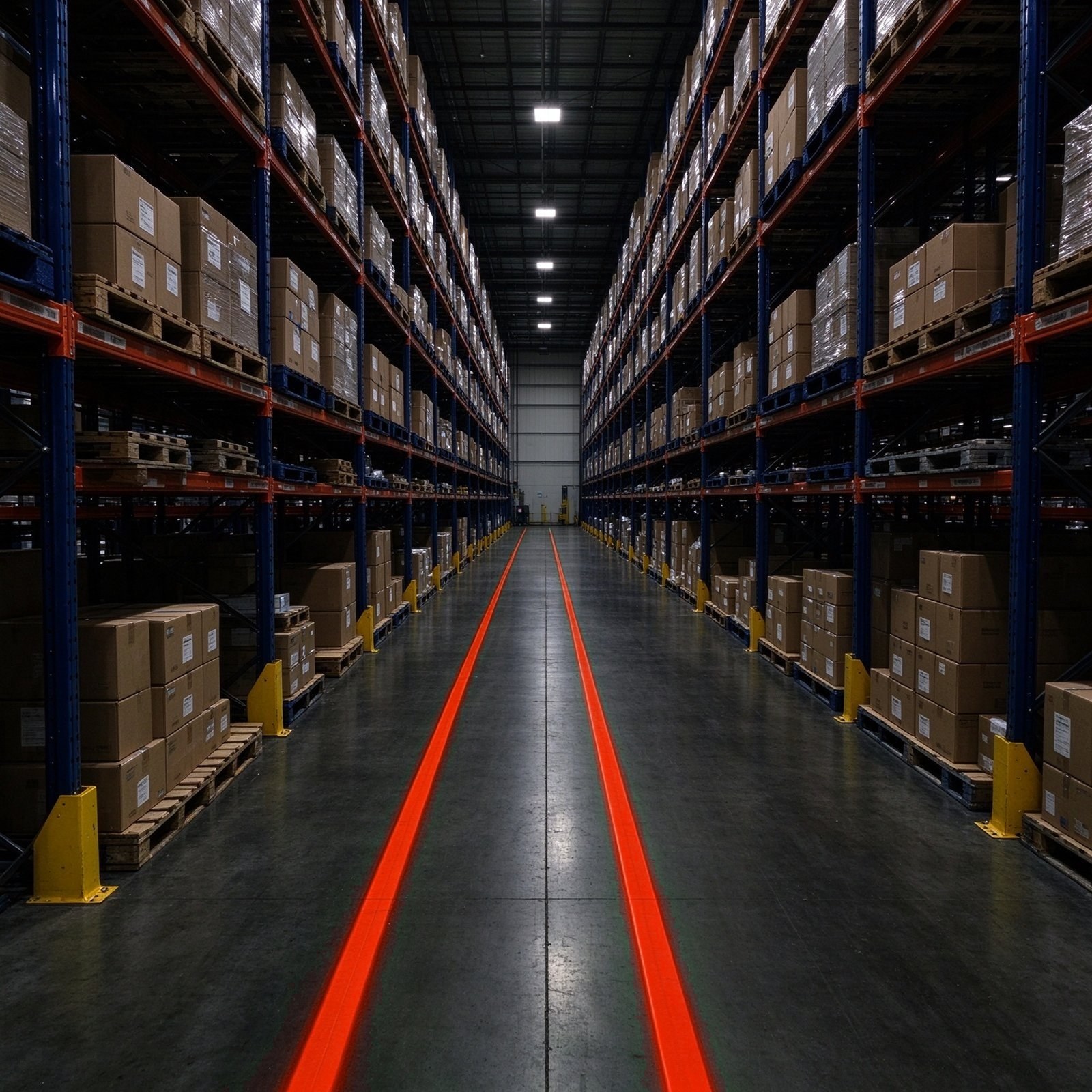
A laser line projector hides a 2 W laser diode behind a cylindrical lens that fans the beam into a thin plane of light. Where that plane cuts the floor, you get a line. Because the beam leaves the lens almost parallel, the line stays visually thin along its whole length — it does not bloom into a soft band the way a projected image does, and it does not dim as quickly with distance.
On our LSL1000 the line reaches 1–9 m, with two available optics (1:1.85 and 1:1.25). The body is a 760 g aluminium housing rated IP65 and −40 to +60 °C, and the source is rated for 50,000 hours. Power draw is about 2 W, so a whole aisle of laser lines costs less to run than a single LED bulb.
How an LED line marker works
An LED line marker is a COB projector with the gobo removed: a high-output chip behind a wide lens throws a strip of light across the floor. Output is measured in lumens, not milliwatts — 9,600 lm at 80 W up to 30,000 lm at 300 W across our Virtual LED Safety Line range, using Osram COB chips.
The trade-off is geometry. The band widens with throw and gets dimmer with the square of the distance, so you choose a lens — 55°, 75° or 100° — to fit the run you actually have. A lens swap is a two-minute job, which is why one housing can serve a 4 m crossing today and a 20 m rack run after the next layout change.
Side-by-side comparison
| Property | Virtual laser line (LSL1000) | Virtual LED line (80–300 W) |
|---|---|---|
| Light source | 2 W laser diode, line-generating optic | Osram COB LED, 9,600–30,000 lm |
| Line character | Thin, hard-edged, roughly constant width | Bright band, widens with throw, tunable by lens |
| Working throw | 1–9 m | Roughly 5–30 m, depending on lens and ambient light |
| Bright ambient light | Contrast drops noticeably in a lit hall | Built for it — this is where high lumens pay off |
| Colour options | Red / green / blue | Yellow / red / green / blue / white |
| Power draw | ~2 W | 80–300 W |
| Housing | IP65, −40 to +60 °C, 760 g | IP40, −45 to +50 °C, indoor duty |
| Mounting | Small bracket, aim at floor, wall or rack face | 360° + 180° bracket, wall or ceiling |
| Coverage per unit | One line, up to 9 m | Roughly 15–30 m of line |
| Relative unit cost | Lower | Higher, but covers far more length per unit |
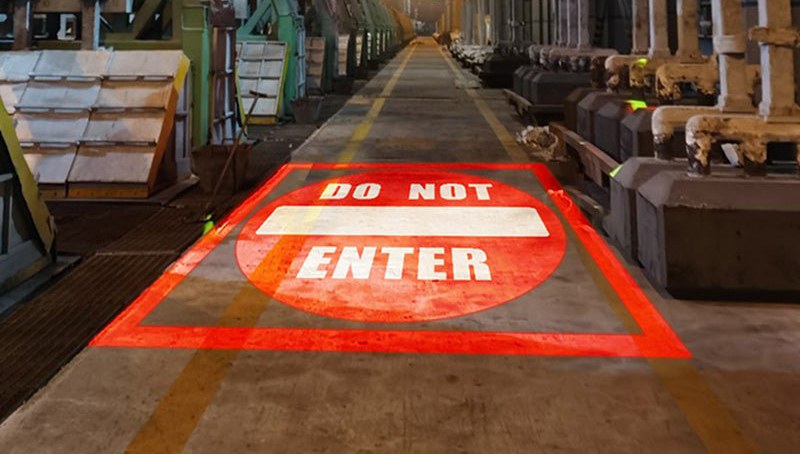
| Typical jobs | No-go boundaries, racking clearance, pick-face lines, night shift | Pedestrian walkways, crossings, dock lanes, lit halls |
The rows that decide most projects are the two middle ones: how bright the room is and how long the line has to be. Everything else is secondary.
When the laser is the better tool
- The line has to land on something other than a floor. A laser will draw a crisp line on racking uprights, a wall, a mezzanine fascia or the side of a machine. An LED projector throws a band that only resolves nicely on a flat horizontal surface.
- Aisles are dim or the site runs a night shift. Low ambient light is where a laser looks almost unreasonably sharp, and where 2 W of coherent light outperforms hundreds of watts of diffuse light.
- You need many short boundaries. Ten 4 m no-go lines around conveyors are far cheaper with ten small laser units than with ten LED markers.
- Power and cabling are awkward. 2 W means you can run several units off one circuit, or off a small DC supply in a remote corner.
- Floor is glossy, oily or uneven. A thin line reads better than a wide band on a surface that reflects or scatters light unevenly.
When the LED line is the better tool
- The hall is brightly lit. Under 300–500 lx of high-bay lighting, a laser line loses contrast; a 150–300 W LED marker still paints a visible lane.
- The line must be a wide, forgiving band. Forklift operators and visitors find a 100–150 mm band easier to follow than a hairline — useful at crossings and visitor routes.
- You need long runs from one mounting point. A 100° lens at 10 m already covers about 23 m of line, which keeps hardware count and cabling down.
- The site uses a five-colour floor code. Yellow, red, green, blue or white lines let you match an existing plant convention without repainting.
- Lines must survive a wash-down or a dusty environment. A sealed LED housing with a flat window is easier to clean than an exposed laser aperture.
Running both in one layout
The strongest layouts mix them, because the two devices solve different problems. A typical mixed layout:
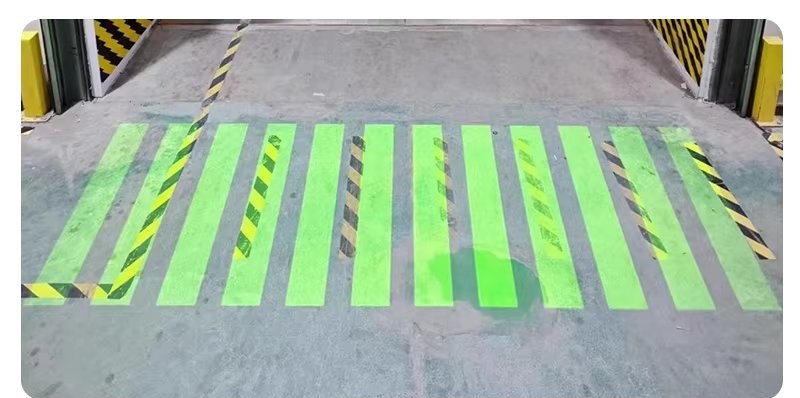
- Green LED line down the centre of the pedestrian walkway — the long, visible lane everyone follows.
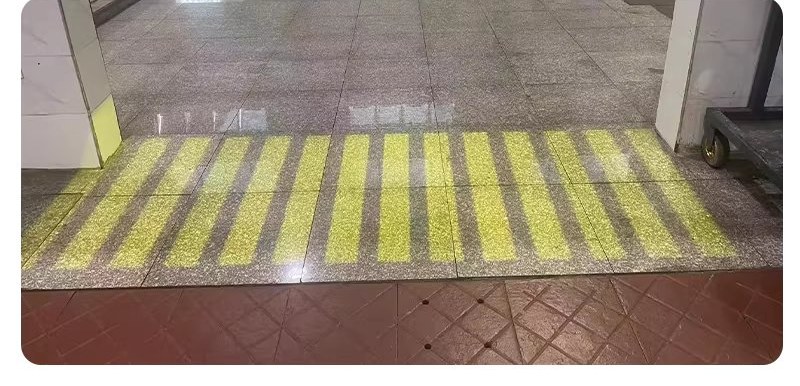
- Yellow LED crossing band across each aisle mouth, so drivers see the crossing before they see a person.
- Red laser line along the rack face at the no-go clearance, where a thin, exact boundary matters more than brightness.
- Blue laser line on the pick-face edge, if your colour code reserves blue for equipment zones.
Two practical notes. First, keep colours consistent with whatever your plant already uses — a new colour system is a training project, not a purchase. Second, aim every unit so the line lands where people look: 1–2 m ahead of the walker, not at their feet.
What to measure before you order
- Line length needed (metres, straight-line, per run).
- Available throw — distance from the mounting point to the middle of the line. This, not the wall height, sets the lens.
- Ambient light at floor level, measured with a lux meter at the busiest shift.
- Surface: sealed concrete, epoxy, tile, steel plate or grating — and how glossy it is.
- Power and access: is there a socket at the mounting point, and can someone reach the unit with a ladder for re-aiming?
Send those five numbers plus a sketch of the aisle and we will come back with a model, a lens and a mounting position — usually within one working day.
FAQ
Is a 2 W laser safe on a busy warehouse floor?
The LSL1000 is a Class 3R laser product. At that class the risk comes from staring into the beam, not from diffuse reflection off a floor. Mount the unit above eye height or aim it steeply downward, keep the warning label visible, and follow your local laser-safety rules and the IEC 60825-1 guidance printed on the housing. If your EHS team has a laser policy, share it with us before ordering and we will confirm the mounting geometry.
Will a laser line still be visible under LED high-bay lighting?
It will be visible but less dominant: colour contrast falls as ambient light rises. If the boundary has to be unmistakable in full production light — for example a walkway that visitors use — an LED line is the safer specification. Many sites run the laser on the rack face and the LED line on the floor for exactly this reason.
Can I change the line length after installation without moving the projector?
On the LED range, yes: swapping to a wider or narrower lens changes the projected length at the same distance. On the laser, the 1:1.25 and 1:1.85 optics give two different lengths from one mounting point. In both cases, re-aiming takes minutes, which is the real advantage over paint.
Do projected lines satisfy floor-marking requirements?
Treat projection as a high-visibility aid that works alongside the markings, signage and traffic plan your safety management system requires — not as a like-for-like substitute for paint in every clause of every standard. Your EHS team or local inspector is the authority on what is required on your site.